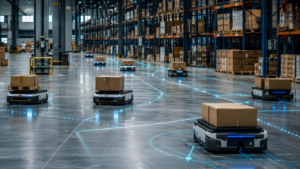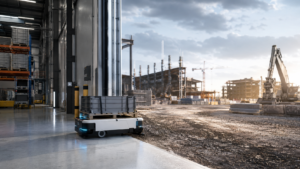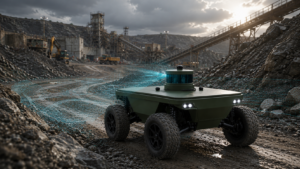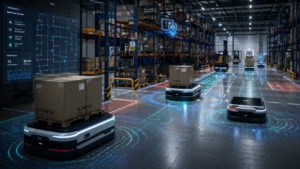
Unmanned Ground Vehicles (UGVs) are transforming the way organizations move materials, inspect facilities, monitor environments, and operate in locations that may be difficult, repetitive, or unsafe for people.
While traditional mobile robots are commonly associated with warehouses and factories, UGVs extend robotic mobility beyond structured indoor spaces. They are designed to operate across a wide range of environments, including industrial yards, construction sites, energy facilities, agricultural areas, mines, campuses, and other outdoor or semi-structured locations.
As robotics, artificial intelligence, machine vision, sensing technologies, and autonomous navigation continue to evolve, UGVs are becoming an increasingly important part of modern industrial automation.
What Does UGV Mean?
UGV stands for Unmanned Ground Vehicle.
In simple terms, a UGV is a vehicle or robotic platform that moves across the ground without requiring a person to physically drive or remain onboard.
Depending on its design and level of autonomy, a UGV may be:
- Remotely controlled by an operator
- Semi-autonomous
- Fully autonomous within a defined operational environment
- Integrated with a centralized fleet management system
- Equipped with cameras, LiDAR, sensors, AI processors, or specialized industrial modules
The main purpose of a UGV is to perform ground-based tasks while reducing the need for continuous human involvement.
What Makes a UGV Different?
Unlike standard indoor mobile robots, UGVs can be designed for more challenging and less predictable environments.
An outdoor or all-terrain UGV may include: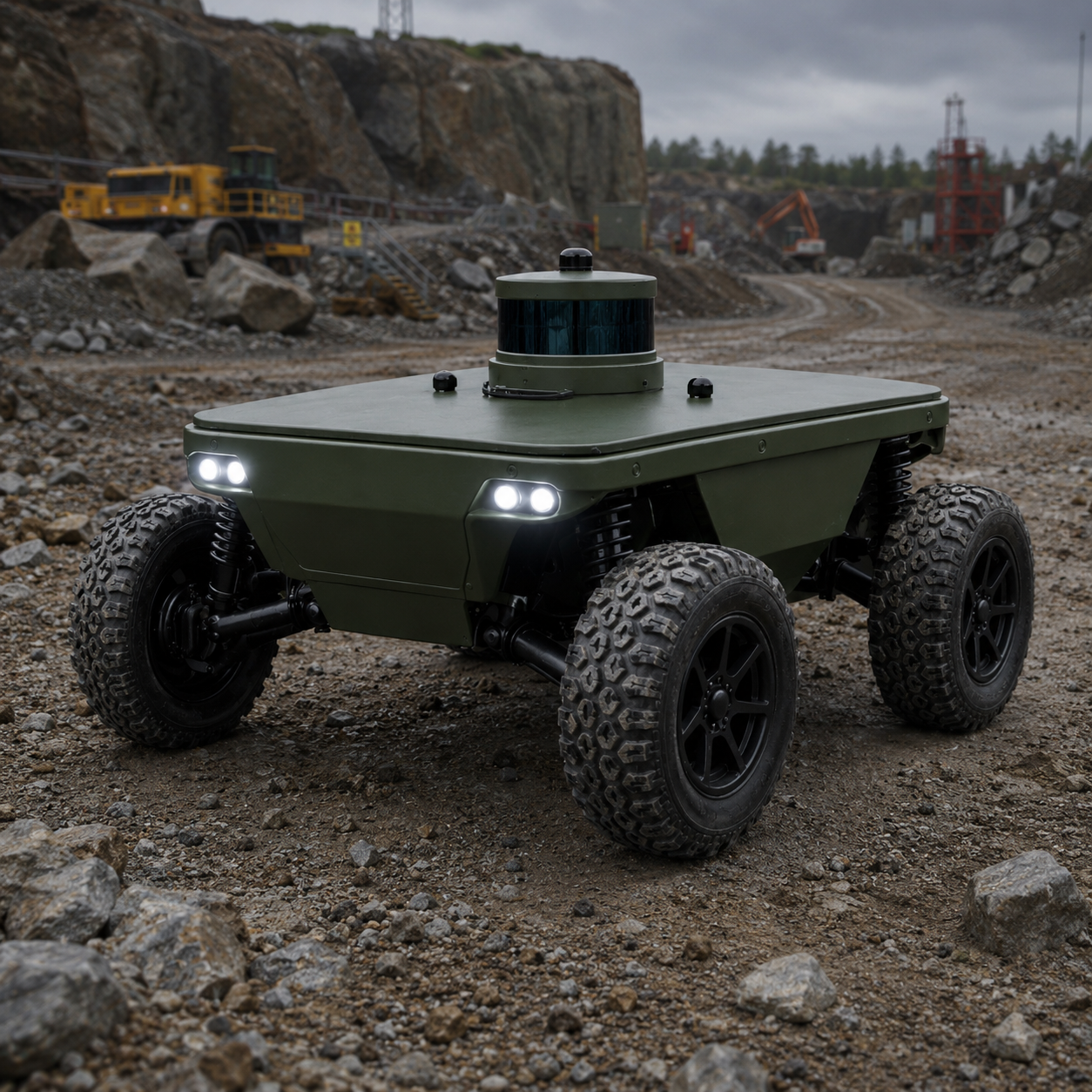
- Rugged and reinforced chassis
- Heavy-duty suspension systems
- Large all-terrain wheels
- Tracked mobility systems
- High ground clearance
- High-torque motors
- Weather-resistant protection
- Dust and water resistance
- Long-range battery systems
- Advanced navigation sensors
- Reliable wireless communication
- Emergency safety systems
These capabilities allow UGVs to operate in environments where conventional warehouse robots may struggle or fail.
The exact design of a UGV depends heavily on its intended application. A wheeled UGV may be suitable for industrial transportation and inspection, while a tracked platform may be more appropriate for loose soil, mud, sand, rubble, or steep terrain.
How Do Autonomous UGVs Navigate?
Modern autonomous UGVs combine several hardware and software technologies to understand their surroundings, determine their location, calculate an appropriate route, avoid obstacles, and complete assigned missions.
Instead of simply following a fixed physical track, advanced UGVs can continuously analyze their environment and make navigation decisions in real time.
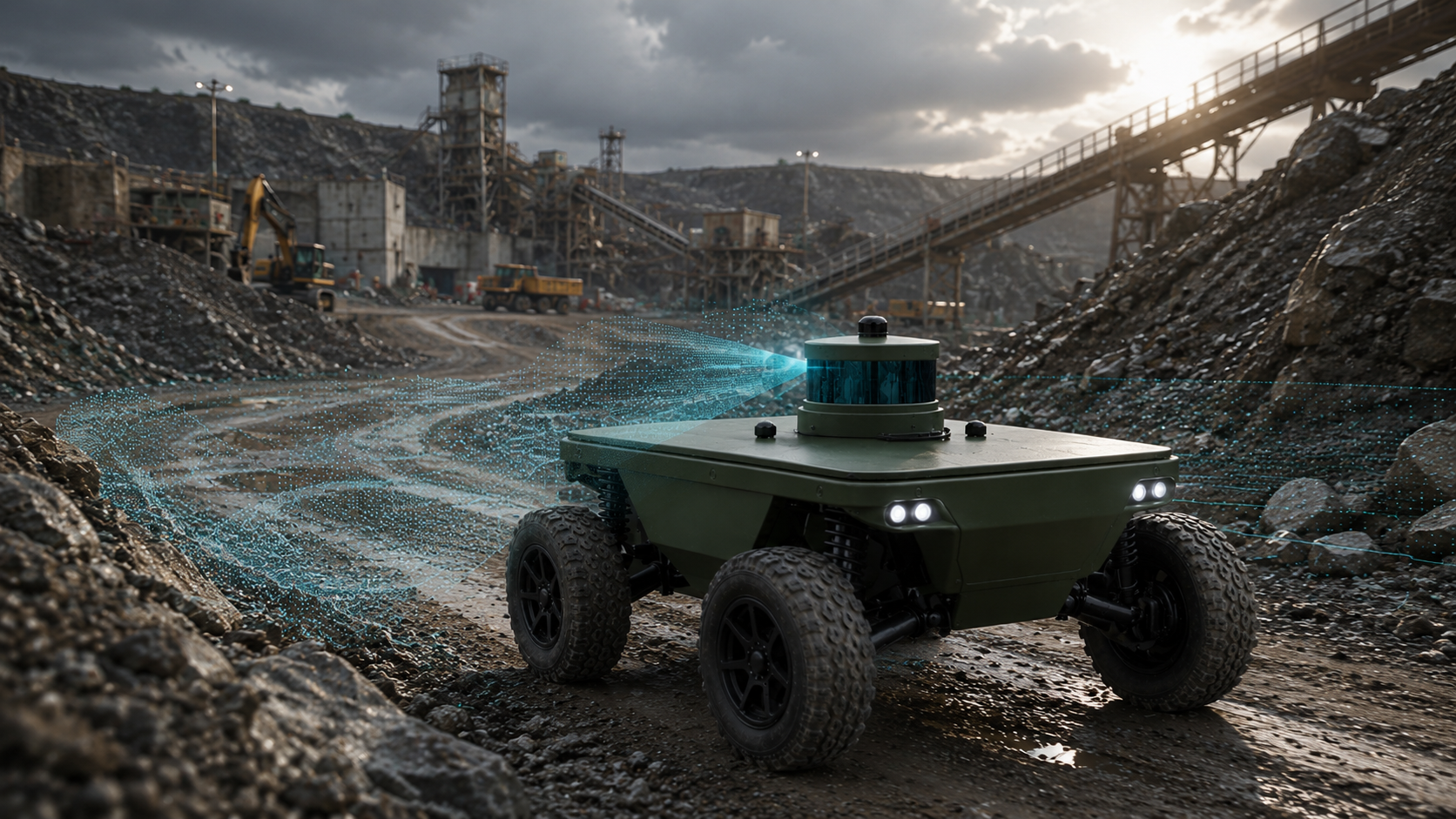
LiDAR Sensors
LiDAR allows a robot to measure distances to surrounding objects and build a detailed representation of its environment.
The information collected by LiDAR can help the vehicle detect obstacles, identify free space, estimate distances, and navigate through complex environments.
Cameras and Machine Vision
Cameras provide additional visual information about the operating environment.
When combined with machine vision and artificial intelligence algorithms, camera systems can help identify objects, recognize environmental conditions, detect people or vehicles, analyze routes, and improve navigation performance.
SLAM Technology
SLAM stands for Simultaneous Localization and Mapping.
This technology enables an autonomous robot to build or update a map of its surroundings while simultaneously estimating its own position within that map.
Unlike older automated transportation systems that may depend on magnetic tape, rails, reflectors, or other fixed infrastructure, SLAM-based robotic systems can provide significantly greater operational flexibility.
Artificial Intelligence
Artificial intelligence can help UGVs process sensor information, identify environmental conditions, select appropriate routes, recognize objects, optimize navigation, and adapt their behavior according to operational requirements.
As AI processing becomes increasingly available directly on robotic platforms, UGVs can make more decisions locally without relying entirely on remote computing infrastructure.
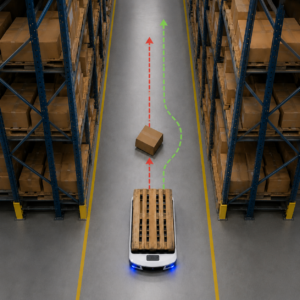
Obstacle Detection and Avoidance
A modern UGV continuously analyzes the area around it while moving.
If an unexpected person, object, vehicle, equipment, or other obstacle appears along its route, the robotic platform can respond according to its navigation and safety configuration.
Depending on the system, this response may include:
- Reducing speed
- Stopping safely
- Recalculating the route
- Moving around the obstacle
- Sending an alert to an operator
UGV vs. AMR: What Is the Difference?
UGV and AMR are closely related terms, but they do not always describe exactly the same type of robotic system.
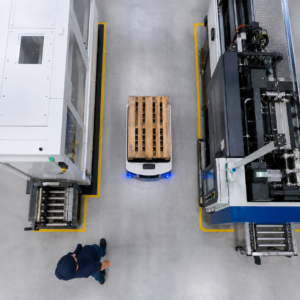
An AMR, or Autonomous Mobile Robot, is typically a mobile robot capable of navigating autonomously within a defined environment.
AMRs are commonly used in:
- Warehouses
- Manufacturing facilities
- Distribution centers
- Production lines
- Hospitals
- Commercial facilities
A UGV, on the other hand, is a broader term describing unmanned vehicles that operate on the ground.
A UGV may be remotely operated, semi-autonomous, or fully autonomous. UGVs are also frequently designed for environments that are less structured than a typical warehouse or production facility.
In practice, an advanced outdoor robotic platform may combine characteristics of both an AMR and a UGV.
Indoor Robots vs. Outdoor UGVs
Indoor autono
mous robots generally operate on relatively predictable surfaces. Factory and warehouse floors are usually flat, clean, structured, and easier for robotic navigation systems to analyze.
Outdoor environments can be significantly more challenging.
An outdoor UGV may need to operate across:
- Asphalt
- Concrete
- Gravel
- Dirt
- Grass
- Uneven surfaces
- Ramps
- Industrial yards
- Construction areas
- Changing environmental conditions
For this reason, outdoor autonomous robots require a different combination of mechanical design, mobility, sensing, control systems, power management, and navigation technologies.
Key Features of an Industrial UGV
The exact specifications of an industrial UGV depend on the application, but modern platforms generally focus on several key capabilities.
Rugged Mobility
Outdoor robots must be capable of operating on surfaces that may not be perfectly flat or predictable.
The drivetrain, wheels, tracks, suspension, chassis, motors, and control systems must therefore be selected according to the intended operating environment.
Autonomous Navigation
Advanced UGVs can determine their position, calculate routes, travel toward assigned destinations, and complete missions without requiring continuous manual control.
Real-Time Obstacle Detection
Sensor fusion allows the robot to continuously monitor its surroundings and respond to dynamic obstacles.
Multiple sensing technologies can be combined to improve environmental awareness and provide greater reliability under changing conditions.
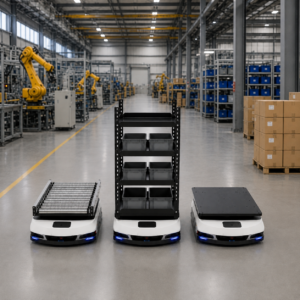
Modular Design
One of the major advantages of industrial robotic platforms is the ability to adapt a common mobile base to multiple tasks.
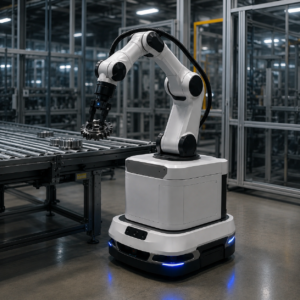
Depending on the application, a UGV may carry:
- Cargo platforms
- Containers
- Inspection equipment
- Standard cameras
- Thermal cameras
- Environmental sensors
- Robotic arms
- Measurement equipment
- Communication systems
- Custom industrial modules
This modular approach allows organizations to use a common robotic architecture across multiple operational scenarios.
Where Are UGVs Used?
UGVs can support a wide variety of industries and operational environments.
Manufacturing
In manufacturing environments, UGVs can transport materials, components, tools, or equipment between production areas.
They can also support logistics between separate buildings, loading areas, storage zones, and production facilities.
Warehousing and Logistics
UGVs can extend automated material transportation beyond the traditional warehouse environment.
For example, autonomous ground vehicles may support movement between storage areas, loading zones, production buildings, outdoor logistics points, and other operational areas.
Mining
Mining environments frequently involve repetitive transportation and inspection activities across difficult terrain.
Robotic ground platforms can support material movement, environmental monitoring, inspection, surveying, and other specialized operations.
Construction
Construction sites are dynamic environments that change continuously.
A flexible UGV can potentially support equipment transportation, monitoring, surveying, inspection, mapping, and other repetitive operational tasks.
Energy and Utilities
Energy and utility facilities may contain large outdoor areas that require regular monitoring and inspection.
UGVs equipped with cameras, thermal imaging systems, gas sensors, or other specialized equipment can support inspection workflows while providing consistent data collection.
Agricu
lture Autonomous ground platforms can support agricultural operations by carrying equipment, sensors, tools, cameras, or other payloads across outdoor environments.
Robotic mobility can also support inspection and monitoring across areas where repetitive manual movement would otherwise require significant time and labor.
Security and Inspection
When equipped with cameras, thermal imaging systems, environmental sensors, or other monitoring equipment, UGVs can perform scheduled inspection and monitoring missions across large facilities.
Material Transportation with UGVs
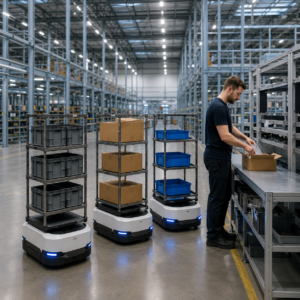
One of the most practical industrial applications of UGV technology is autonomous material transportation.
Traditional material movement frequently depends on manually operated vehicles or repetitive human labor.
An autonomous UGV can instead receive transportation missions from a management platform and execute those missions automatically.
When connected to industrial systems, autonomous transportation can become part of a larger automated workflow.
This can improve operational consistency while allowing employees to focus on higher-value activities that require human judgment, technical expertise, communication, or decision-making.
Fleet Management
Organizations do not necessarily need to manage every UGV independently.
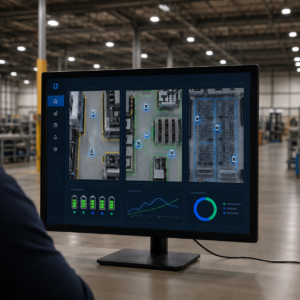
Multiple robotic platforms can be connected to a centralized fleet management system.
A fleet management platform may coordinate:
- Mission assignment
- Robot status monitoring
- Route coordination
- Traffic management
- Battery monitoring
- Charging management
- Operational analytics
- Error and event reporting
- Robot availability
- Performance monitoring
As the number of deployed robots increases, intelligent fleet coordination becomes increasingly important for scalable automation.
Integration with Existing Industrial Systems
A modern autonomous robotic system should not necessarily operate as an isolated technology.
UGVs can become significantly more useful when connected to existing operational infrastructure.
Depending on the application, robotic platforms may integrate with:
- ERP systems
- Warehouse Management Systems (WMS)
- Manufacturing software
- Industrial control systems
- Fleet management platforms
- Monitoring dashboards
- Custom enterprise applications
For example, a warehouse or production management system could generate a transportation request and automatically assign that task to an available robot.
The UGV completes the mission while operational information is returned to the management platform.
Benefits of Using UGVs
Reduced Repetitive Manual Work
Repetitive transportation and inspection activities can consume significant employee time.
Automating these tasks allows human teams to focus on activities requiring judgment, creativity, communication, technical expertise, or specialized decision-making.
Improved Operational Consistency
Robotic platforms can execute predefined workflows consistently and provide structured operational data.
Increased Safety
UGVs can support tasks in environments that may be physically demanding, difficult to access, repetitive, or potentially hazardous.
Greater Operational Visibility
Connected robotic systems can provide real-time information about missions, robot status, transportation activity, system events, and operational performance.
Scalability
Organizations can begin with a small number of robotic platforms and
gradually expand the fleet as operational requirements increase.
Flexible Automation
Unlike infrastructure-heavy automation systems, modern autonomous mobile robots can often adapt more easily when layouts, routes, workflows, or operational requirements change.
What Should You Consider Before Deploying a UGV?
Successful robotic automation begins with understanding the real operational problem.
Before selecting a UGV, organizations should evaluate several important factors.
Terrain
What surfaces will the robot operate on?
A robot operating on smooth indoor concrete requires very different mobility characteristics from a platform operating on gravel, dirt, grass, rubble, or uneven outdoor terrain.
Payload
The weight, dimensions, center of gravity, and type of equipment or materials carried by the robot must be considered during system design.
Operating Environment
Important environmental conditions may include:
- Slopes and inclines
- Narrow passages
- Pedestrian traffic
- Other vehicles
- Weather exposure
- Dust
- Lighting conditions
- Surface irregularities
- Operating temperature
Required Level of Autonomy
Some applications require fully autonomous navigation, while others may benefit from remote operation, semi-autonomous functionality, or hybrid control.
Safety Requirements
Safety architecture must be evaluated according to the robotic platform, operating environment, application requirements, surrounding personnel, and applicable safety procedures.
System Integration
Organizations should determine whether the robot must communicate with ERP software, WMS platforms, machines, industrial systems, doors, elevators, sensors, control systems, or other infrastructure.
The Future of Unmanned Ground Vehicles
UGV technology continues to evolve rapidly.
Advances in artificial intelligence, edge computing, computer vision, sensing technologies, battery systems, sensor fusion, and autonomous navigation are making robotic ground platforms increasingly capable and adaptable.
The next generation of UGVs is moving beyond basic transportation.
Robotic platforms are increasingly becoming intelligent mobile systems capable of combining transportation, sensing, mapping, data collection, inspection, monitoring, and automation within a single platform.
This shift opens the door to much broader automation opportunities across industrial environments.
FASTA Robotics and Outdoor Autonomous Mobility
At FASTA Robotics, we develop intelligent robotic solutions for real industrial environments.
Our approach combines autonomous navigation, machine vision, sensing technologies, intelligent control, and modular robotic architecture to create platforms that can be adapted to different operational requirements.
For applications extending beyond traditional indoor automation, the FASTA X-Series provides a robotic platform designed around outdoor mobility and challenging industrial environments.
Whether the requirement involves materi